
eNews
#05 2025
Heuweltjie-Covered Landscapes of Western South Africa – Interpretive Fieldtrip Guidebook: A new open-access resource
By Joseph R. McAuliffe, Desert Botanical Garden, Phoenix, Arizona USA and Catherine E. Clarke, Department of Soil Science, Stellenbosch University
A new guidebook focused on heuweltjies and the environments in which they occur is now freely available online (Figure 1). Heuweltjies are the regularly spaced earthen mounds found throughout most of the Succulent Karoo, the Sandveld of the West Coast, and some types of fynbos vegetation. Researchers have long debated the origins of heuweltjies, and the guidebook provides comprehensive coverage of recent findings. The guidebook contains a wealth of information regarding many other aspects involving geological phenomena, soils and organisms associated with the mounds.
Creation of the guidebook was an outgrowth of an international collaboration of a group of researchers who initiated a three-year project in 2023 to investigate soil processes in heuweltjies involved in the sequestration of carbon dioxide from the atmosphere. The collaborators include nine senior researchers and graduate students from four universities in South Africa (Stellenbosch University, University of Pretoria, University of the Western Cape and Nelson Mandela University) and three institutions from the United States (Kent State University, University of Texas at Austin and the Desert Botanical Garden). Disciplines represented by this set of researchers include geology and geochemistry, soil science, molecular genetics, microbiology and plant ecology. This broad range of expertise is necessary to address fundamental questions about processes that occur in the soil involving plants, termites and microbes that enrich the soils with calcium carbonate, thereby acting as a natural mechanism of carbon sequestration.
The three-year project1 was funded through a partnership of the U.S.A. National Science Foundation (NSF) and the South African National Research Foundation (NRF) to promote opportunities for international collaboration. That international programme, Biodiversity on a Changing Planet (BoCP), initiated by the NSF, was developed to support international collaboration in interdisciplinary research that addresses major challenges at a time of unprecedented environmental changes worldwide, including climate change.
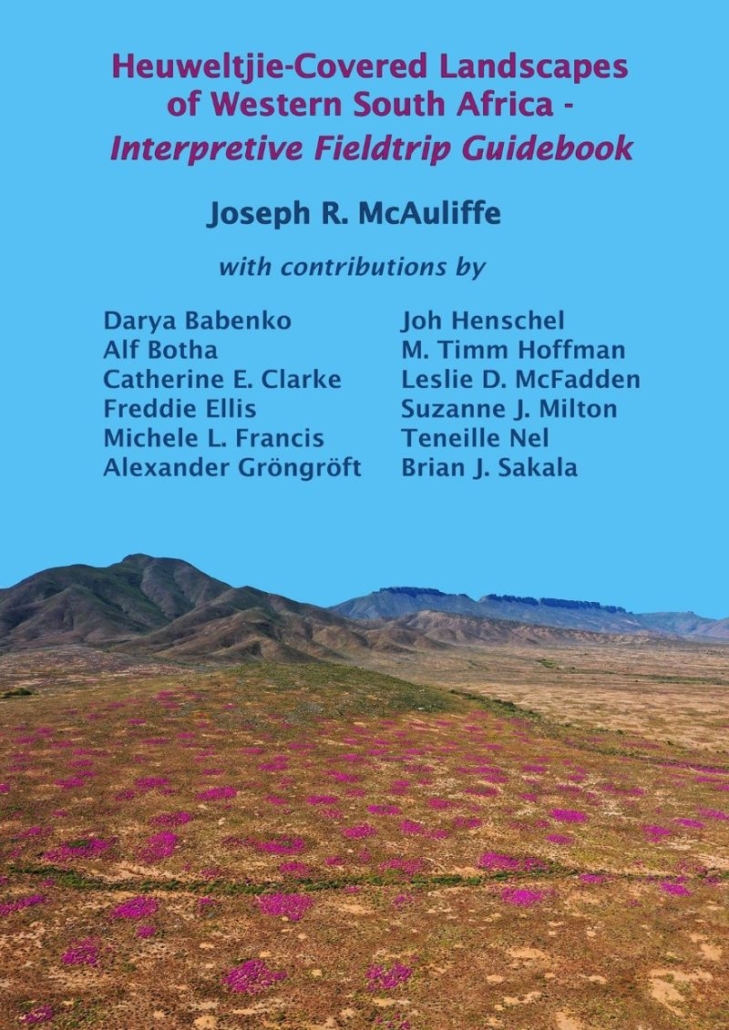
Figure 1. Cover of the guidebook with an aerial drone photograph that shows a dazzling display of colour on heuweltjies during the spring bloom northeast of Vanrhynsdorp, Western Cape.
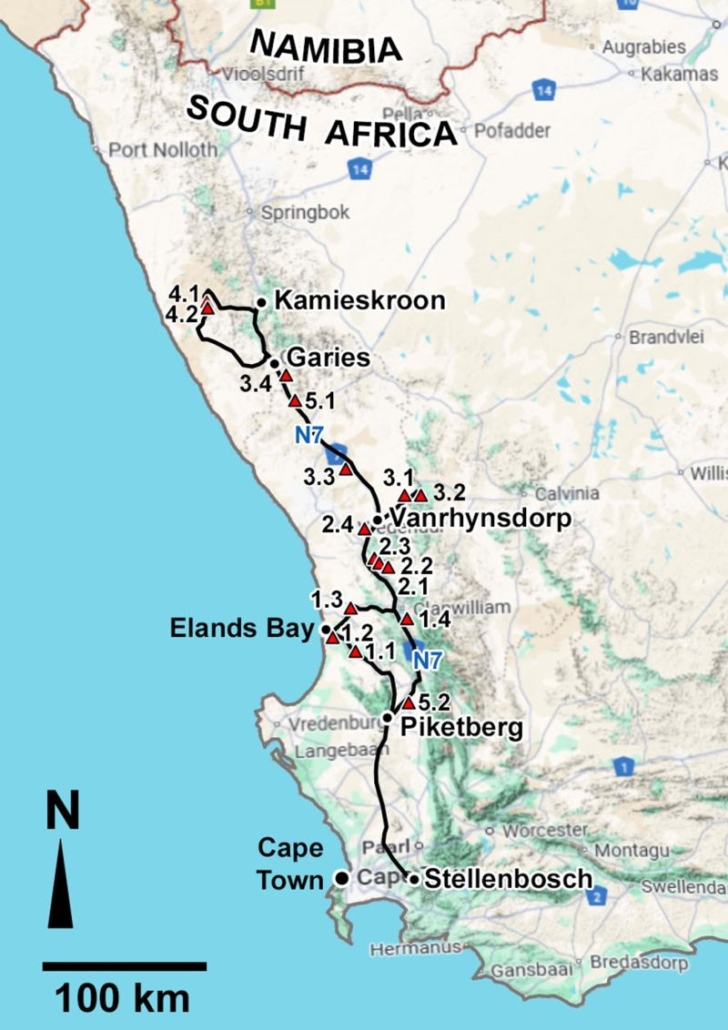
Figure 2. Map of western South Africa showing the travel route described in the guidebook and locations of 16 numbered interpretive stops along the route (red triangles).
The 431-page guidebook is divided into two major sections. The first contains detailed road logs for travel to a set of 16 interpretive stops distributed along a five-day travel route from Stellenbosch to locations in Namaqualand 420 km to the north (Figure 2). The second section contains 28 Digging deeper chapters, each focused on particular topics involving heuweltjies and the environments in which they occur.
In addition to providing detailed information regarding the interpretive stops, the Digging deeper chapters independently provide comprehensive compilations and syntheses of available information and knowledge, as well as yet-unpublished research findings. The guidebook contains technical information of value to researchers yet is written in a style intended to be comprehensible to non-specialists, and of use to anyone interested in natural history, geology, ecology and conservation. The road logs and Digging deeper chapters are richly illustrated, with over 350 figures (maps, photographs and diagrams) and tables (Figure 3).
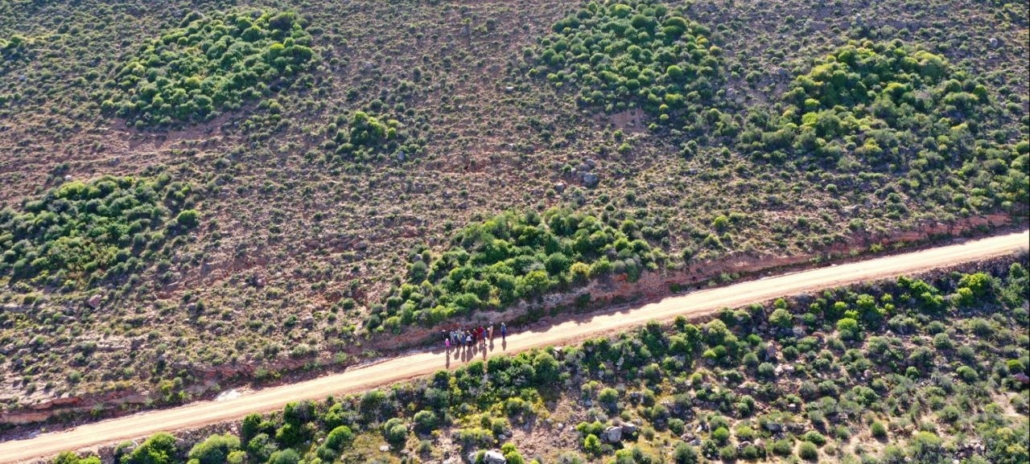
Figure 3. Aerial drone photograph of heuweltjies at Interpretive Stop 2.1 included in the Day 2 road log. The heuweltjie in the centre was cut in the process of road construction, offering an unparalleled view of the internal structure of the mound, which is described in detail in Digging deeper #10 – Heuweltjie stratigraphy.
A total of 76 pages is devoted to five separate road logs for the trip north from Stellenbosch. The interpretive stops in the road logs include important research sites where key investigations on heuweltjies have been conducted. Detailed maps showing routes to these sites are included throughout (Figure 4). In addition to the five road logs, a description of a walking tour in the Coetzenburg hiking area on the south side of Stellenbosch, and research on heuweltjies in that area, are included.
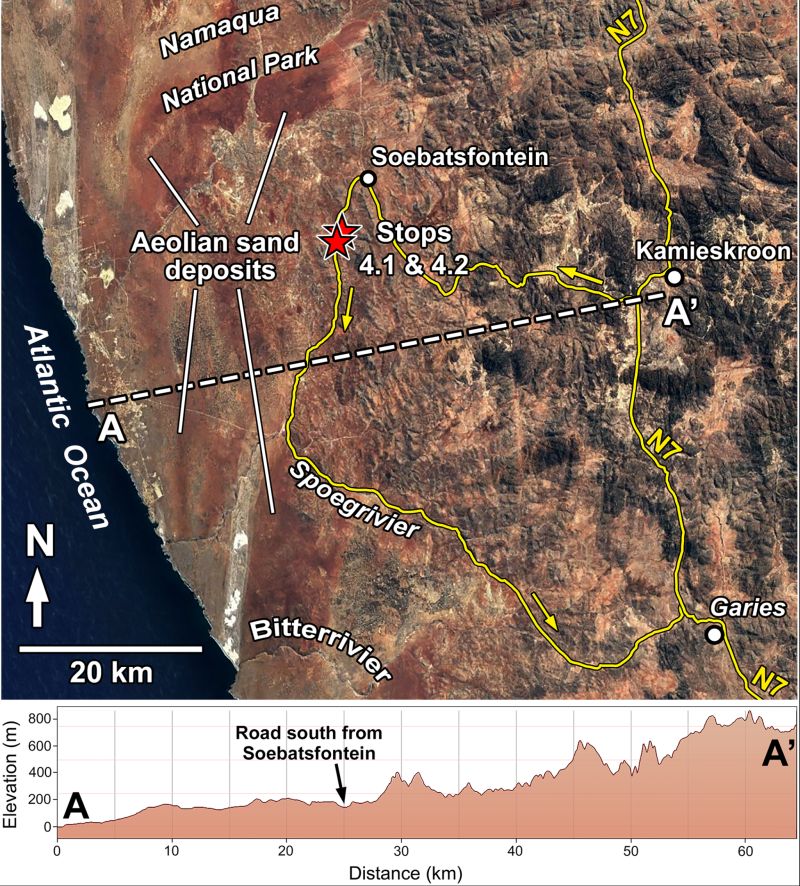
Figure 4. An example of one of the detailed maps included in the road logs. This map shows the route of the “heuweltjieveld loop tour” described in the Day 4 Road log. The illustration also shows the elevation profile (lower panel) from east to west in this coastal region along the dashed line A-A’ in the map.
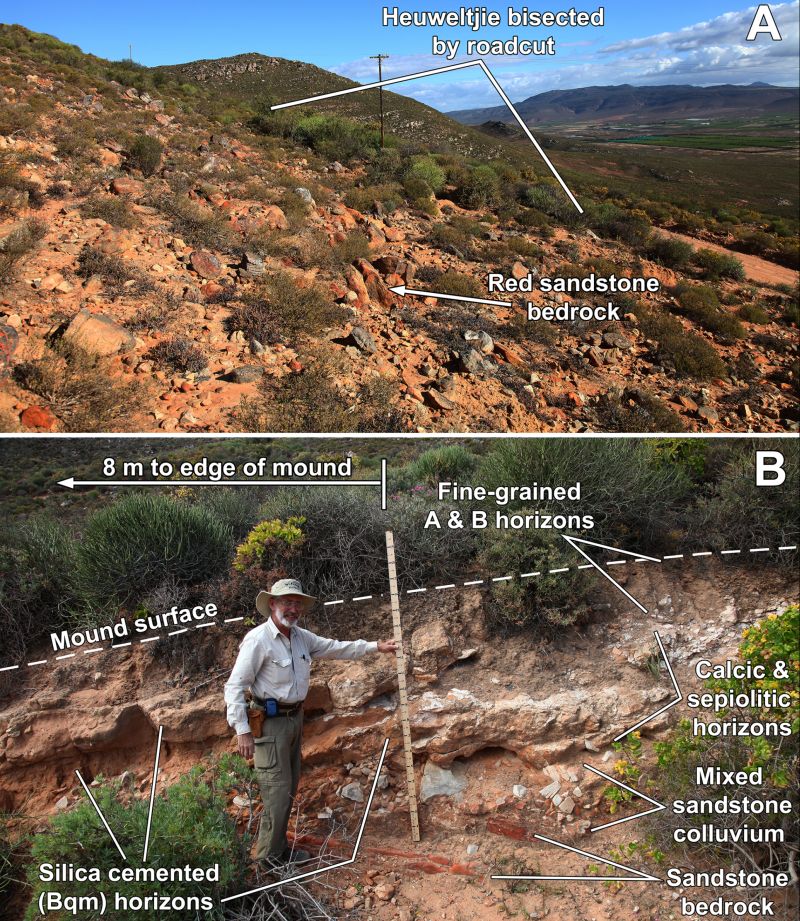
Figure 5. One of the illustrations in Digging deeper #10 – Heuweltjie stratigraphy that portrays details of the stratigraphic structure of the cross-sectioned heuweltjie shown in aerial perspective in Figure 3. The chapter describes the details of various soil and stratigraphic units as well as the process by which the mound formed.
A total of 408 pages is devoted to the 28 Digging deeper chapters, which delve into particular features that are observed at the interpretive stops described in the road logs. Individual chapters contain detailed presentations on specific topics regarding heuweltjies, including:
- Age of heuweltjies
- Modelling how heuweltjies form
- Heuweltjies and biodiversity
- Carbon storage in heuweltjies
- Salt accumulation in heuweltjies
- Effects of livestock grazing on heuweltjies
These thematic chapters provide comprehensive compilations and assessments of published research results, and in some cases, new findings and key observations that have yet to be formally published. Other chapters provide information on various environments where heuweltjies occur in the West Coast region, including:
- Episodes of aeolian deposition in the Sandveld
- The Sandveld: Conservation concerns
- Silica-cemented soil horizons: Dorbank and silcrete
- Knersvlakte, the white quartz plains of Namaqualand
Like the detailed road logs, the Digging deeper chapters are illustrated with photographs, maps, diagrams and tables that effectively portray various phenomena and information involving geology, soils and organisms (e.g. Figure 5).
The entire volume is an essential resource for researchers and students involved in investigation of various aspects about heuweltjies.
The Digging deeper chapters collectively present the most comprehensive and up-to-date compilation of available knowledge about heuweltjies. Despite the wealth of detailed information that is presented, the text is written in a manner to be accessible to a wide audience. The PDF version available on the web is formatted for standard A4 (21 x 29.7 cm) paper, which allows one to print the entire document or portions as desired.
The guidebook is written in English, but creation of an Afrikaans version is now in progress, with a targeted completion in December 2025 or early 2026. Like the English language version, it will be made available through Stellenbosch University’s open-access website portal SUNScholar and the NSF’s Public Access Repository (PAR).
Access the English version of the guidebook here:
https://scholar.sun.ac.za/items/31e797a4-b6b0-48b1-8ad9-c73b52b06c6a
1 Project title: Collaborative Research: BoCP-Design: US-South Africa: Turning CO2 to stone: the ecosystem service of the oxalate-carbonate pathway and its sensitivity to land use change supported by the NRF-NSF Biodiversity on a Changing Planet (BoCP) programme (NSF grant number DEB-2224993, NRF grant number 150452).